
Table of contents
The Problem with Current AI Transformation
Despite spending $30-40 billion, 95% of organizations have seen zero return on AI investment. What they have seen includes:
- Scattered, one-off pilots
- Siloed data and learning
- Inconclusive results
- No clear next steps for scaling AI
- Growing fear and skepticism of AI within the workforce
NOBL is a AI transformation consultancy that’s partnered with some of the world’s largest public companies to implement AI (and avoid those common mistakes). And we’ve noticed one glaring issue: no one has a clear vision for what a truly AI-enabled organization looks like.
So we built one.
The hardest part of AI isn’t the tech. It’s getting people to change the way they work. – Satya Nadella
We call it the “Self-Driving Organization.” But because autonomy isn’t a switch—it’s a journey—we’ve also identified the six levels that organizations go through on their way to full autonomy. (Spoiler: no organization has reached that level yet.) Each level includes a brief case study from a company with successful AI pilots, as well as recommendations for what leaders can implement, right now, to work towards AI at scale.
What Is a Self-Driving Organization?
Every technological shift has changed what organizations can sense, decide, and do. The industrial age expanded how far we could act. The information age expanded what we could know. Now AI expands how we can decide: systems that interpret goals, weigh trade-offs, and with a speed no hierarchy could hope to match.
A self-driving organization is one that can sense, learn, and adapt continuously through a partnership between people and intelligent systems. Humans define purpose, ambition, and values. Systems translate that intent into action, learning and improving with every cycle.
Together, it becomes a model of progression; from isolated AI pilots to a connected, learning enterprise.
What Are the Levels of AI Transformation?
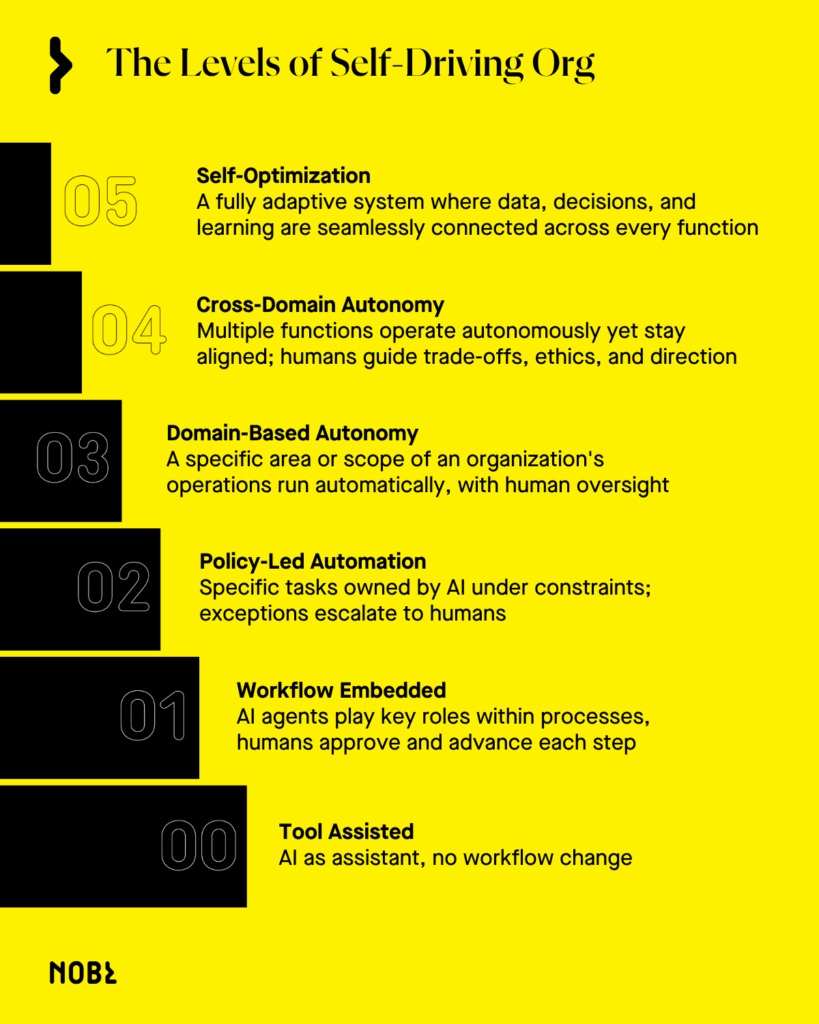
To improve AI capabilities, leaders must first understand their organization’s current level of AI transformation. NOBL has identified six, from most basic to most integrated:
- Level 00, Tool-Assisted: AI serves as an assistant, but there are no changes to the workflow.
- Level 01, Workflow Embedded: AI agents play key roles within processes, while humans are responsible for approving and advancing each step.
- Level 02, Policy-Led Automation: Specific tasks are owned by AI under constraints; exceptions escalate to humans.
- Level 03, Domain-Based Autonomy: A specific area or scope of an organization’s operations runs automatically, with human oversight.
- Level 04, Cross-Domain Autonomy: Multiple functions operate autonomously yet stay aligned; humans guide trade-offs, ethics, and direction.
- Level 05, Self-Optimization: A fully adaptive system where data, decisions, and learning are seamlessly connected across every function.
Level 00: Tool-Assisted
At the most basic level, teams use AI tools in isolation: to write prompts, generate slides, and automate outputs—but nothing really connects.
AI Transformation Case Study: American Express
More than seventy generative AI experiments are underway—from drafting internal reports to improving customer service interactions. Each team tests different tools and approaches, learning through trial and error rather than through centralized coordination. The result is a surge of creativity and productivity, but with fragmented data and outcomes that don’t yet connect.
Achieving this level of AI transformation requires:
- Shared data hygiene: compiling, cleaning, and tagging what matters to future systems can learn
- Internal AI policy: clear guidance on what’s safe, what’s restricted, and where human review is required
- Training and inspiration: internal demos, brown bags, and show-and-tells that highlight early wins
- Prompt library and templates: reusable examples that standardize quality and reduce duplication
- Centralized experimentation log: a shared place where teams record what they tried, what worked, and what didn’t
- Tool inventory and access controls: know which teams are using which tools, and why, to reduce overlap and risk
Level 01: Workflow Embedded
A slightly more advanced use of AI where it supports specific, repeatable parts of a process, like drafting briefs or summarizing updates. Humans still own final decisions, but AI is part of the workflow, not just the toolbox.
AI Transformation Case Study: Pfizer
Pfizer’s regulatory and clinical teams now rely on AI to summarize trial data and draft documentation, with scientists reviewing and refining every output before submission. What once took weeks of manual effort now happens in hours—but the workflow still begins and ends with human judgment. The AI’s role is to accelerate routine work and free experts for interpretation. It’s a prime example of embedding AI into a process while keeping people accountable for what matters most.
Achieving this level of AI transformation requires:
- Process mapping and role definition: identify where AI adds clarity or speed, and where human review remains essential
- Quality and bias checks: establish acceptance criteria, sampling reviews, and human sign-off points
- Feedback loops: capture human edits and corrections to continually retrain or refine prompts
- Workflow instrumentation: log inputs, outputs, and performance metrics for transparency
- Change enablement: train teams on how their process shifts (new rhythms, new review habits)
- Cross-functional champions: appoint “workflow owners” to maintain consistency and share lessons learned
Level 02: Policy-Led Automation
At this level, AI begins making defined decisions within established boundaries: routing requests, approving low-risk items, or adjusting schedules automatically. Humans step in for exceptions, ethics, and edge cases.
If you can replace judgements by rules and algorithms, they’ll do better. – Daniel Kahneman
AI Transformation Case Study: Wells Fargo
Wells Fargo’s Customer Decision Hub provides real-time modeling and adaptive machine learning that allows the bank to constantly recalculate each individual’s “next best conversation” while those individuals are interacting in-channel. This not only ensures each customer message is relevant, but it also helps the bank introduce new conversations that are designed to help struggling customers build financial resilience.
Achieving this level of AI transformation requires:
- Decision audits: map out which choices are made most often, by whom, and using what (sometimes unspoken) criteria
- Rule codification: translate “how we usually decide” into structured policies, thresholds, and triggers— in plain language first, code second
- Exception design: define when and how human intervene, and what authority they retain
- Governance alignment: involve Legal, Risk, HR, and Ops early to agree on the boundaries of automation
- Transparency tooling: build dashboards showing every automated decision and its rationale
- Feedback and redress: give employees and customers a way to question or overturn automated outcomes
- Leadership recalibration: coach managers through the power shift—from bending rules to designing the rules
- Ethical stress tests: run scenarios where automated rules could conflict with values, to refine before scaling
Level 03: Domain-Based Autonomy
AI capabilities are increasing. A specific domain (e.g., marketing operations, supply chain, or customer service) operates autonomously under human oversight. AI systems handle most day-to-day decisions, learning from results and optimizing toward shared metrics. Humans guide priorities, ethics, and exceptions but no longer manage every decision directly.
The first rule of any technology used in a business is that automation applied to an efficient operation will magnify the efficiency. The second is that automation applied to an inefficient operation will magnify the inefficiency. – Bill Gates
AI Transformation Case Study: ORION
In 2016, ORION was deployed nationwide. With it, UPS could perform 30,000 route calculations per minute. Over $250 million was invested in building it, but the savings have exceeded $300 million per year. That also includes 10 million gallons of fuel and 100,000 metrics tons of CO2 emissions.
Achieving this level of AI transformation requires:
- End-to-end process mapping: document the full flow of inputs, decisions, and outputs across the domain
- System-of-record integration: connect the data backbone (CRM, ERP, HRIS, etc.) to allow closed-loop learning
- Shared success metrics: align humans and AI on what “good” means
- Autonomy charters: define scope, boundaries, and escalation paths so everyone knows where AI acts independently
- Cross-functional governance: include Finance, Legal, HR and IT in domain oversight to avoid siloed drift
- Transparency dashboards: visualize decisions, confidence levels, and exceptions in real time
- Feedback rituals: hold regular “AI performance reviews” where humans examine outcomes and tune policies
- Leadership adaptation: help managers shift from supervising people to supervising systems (translating goals, not micromanaging workflows)
Level 04: Cross-Domain Autonomy
The organization has achieved AI at scale. Multiple autonomous domains (e.g., marketing, operations, finance, HR) now coordinate through shared data and objectives. AI systems negotiate trade-offs across boundaries: reallocating resources, synchronizing forecasts, and resolving conflicts in real time. Humans oversee alignment, ethics, and long-term direction; steering the system when strategy or context changes.
AI Transformation Case Study: Zara
Zara’s AI trend prediction capabilities integrate seamlessly with supply chain operations that enable rapid transition from trend identification to product availability. The entire system operates as coordinated intelligence and execution capability that delivers products to market faster than traditional fashion retail approaches.
Achieving this level of AI transformation requires:
- Shared data infrastructure: unify metrics and ontologies (concepts and the relationships between them) so domains “speak the same language”
- Cross-domain policy frameworks: codify how local systems negotiate priorities (e.g., cost vs. service vs. risk)
- Objective hierarchies: define enterprise-level goals that cascade into domain-level KPIs
- Simulation environments: use digital twins or scenario testing to see how changes ripple across functions
- Alignment governance: form a cross-functional council to review how automated decisions interact
- Transparency layer: dashboards that show inter-domain dependencies, trade-offs, and anomalies
- Incentive realignment: update performance systems so leaders are rewarded for total-system outcomes, not silo wins
- Cultural reinforcement: retrain leaders to think like designers of ecosystems, not defenders of turf
Level 05: Self-Optimization
AI at scale has progressed to a fully adaptive system where data, decisions, and learning are seamlessly connected across every function. The organization senses change, reallocates resources, and refines strategy in real time—continuously closing the loop between insight and action. Humans define purpose, values, and constraints; intelligent systems interpret and execute within them. Together, they form a co-creative network that learns faster than the environment around it.
No company has fully reached Level 05 yet—where AI systems coordinate seamlessly across domains and make decisions on the organization’s behalf—but the trajectory is clear. Within a few years, the frontier won’t be building AI tools; it will be building organizations intelligent enough to use them as one mind.
Achieving this level of AI transformation requires:
- Enterprise nervous system: connect every domain through shared data contracts, feedback loops, and standardized APIs
- Adaptive governance: embed real-time monitoring, ethical auditing, and “kill-switch” protocols into every automated layer
- Human constitution: codify rights to transparency, appeal, and influence—keeping people central to oversight and meaning
- Dynamic strategy systems: link market sensing directly to portfolio and resource decisions, with humans curating intent
- Continuous learning pipelines: feed outcomes back into model retraining, policy refinement, and leadership development
- Scenario rehearsal: run simulations that test values and trade-offs under stress, ensuring alignment through turbulence
- Meta-metrics: measure not only output performance but learning velocity; how quickly the organization improves itself
- Leadership evolution: leaders focus on narrative, ethics, and system design; shaping the organization’s sense-making, not its micromanagement
What’s Required for Successful Automation
Make no mistake: the horizon isn’t just technological—it’s organization, and deeply human. Machines may execute tasks, but only humans provide the ethics, judgment, and imagination that give those actions meaning and impact. And without human workers, there’s no consumer base, no demand, no prosperity.
Mankind and machine is the only future worth building.
Artificial intelligence is not a substitute for human intelligence, it is a tool to amplify human creativity and ingenuity. – Fei Fei Li
But partnership between mankind and machine doesn’t happen default. To make collaboration between humans and machines real, every AI system must meet three non-negotiable requirements:
- Transparency. The system’s logic, data, and decisions must be visible and understandable to those who rely on it.
- Agency. Humans must retain the authority to question, override, and improve the system’s outputs.
- Meaning. The work that remains for people must be substantive, rewarding, and aligned with shared values.
Without these, there is no partnership—only automation without alignment.
What Determines the Success of AI at Scale
The future of AI depends on how we design our organizations.
Transparency, agency, and meaning can’t be hard-coded; they have to be designed and embedded into how people, processes, and systems interact. That’s the work of organizational design. It defines how authority, accountability, and learning flow through the system.
The ability to learn faster than competitors may be the only sustainable competitive advantage. – Arie de Geus
In the AI era, organization design is the architecture of alignment—the structure that keeps intelligence and intent moving in the same direction. And building a self-driving organization starts with seeing where you stand. Request NOBL’s Self-Driving Org Diagnostic: a quick assessment of your AI maturity and design readiness.